
With its Battery-as-a-Service (BaaS) model Tata Motors just redrew the EV battle lines, says Rajesh Karkera/Rediff.com

Government schemes such as the PM E-Drive initiative, with allocations of around Rs 2,000 crore for charging points deployment, are helping accelerate rollout
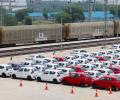
While GST on ICE vehicles was brought down significantly, for electric cars it remained at 5 per cent.

Mahindra & Mahindra (M&M) Ltd reported a significant 34 per cent year-on-year increase in Profit After Tax (PAT) to Rs 5,455 crore for the June quarter, driven by strong performance in its Auto and Farm segments despite challenging macro-economic conditions.

India's domestic passenger vehicle sales experienced a robust 24.6 per cent year-on-year increase in June, propelled by favourable government policies like income tax relief and repo rate cuts, alongside resilient rural demand, even as global crude oil prices pose potential cost pressures.

Honda is re-entering the Indian market with the ZR-V, a premium hybrid SUV designed to be a halo product and showcase its global line-up, despite its high import price and some missing features.

Electric vehicle (EV) manufacturers breathed a sigh of relief after the GST Council on Wednesday night retained the concessional 5 per cent rate on EVs, though they now face competition from small petrol and diesel cars, which will attract a lower 18 per cent levy.

Mercedes-Benz India is exploring a larger role for plug-in hybrid electric vehicles (PHEVs) in its portfolio, with plans to potentially introduce the technology in more models beyond the newly launched S-Class plug-in hybrid. This strategy aims to cater to luxury car buyers who are hesitant about fully electric vehicles due to concerns over charging infrastructure and range.

The Delhi government has approved the Delhi EV Policy 2.0, which will phase out fresh registrations of internal combustion engine (ICE) two-wheelers and three-wheelers over the next two years, starting with a ban on ICE 3Ws and N1 category LCVs from January 1, 2027, and ICE 2Ws from April 1, 2028.
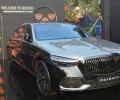
What we will not do is discount deeply, neither will we compromise on product substance, says Managing Director and Chief Executive Officer (MD&CEO) Santosh Iyer.

'...as we believe with the adoption of AI, our IT services companies' revenue models will have to undergo a reset, which may in turn impact their potential for earnings growth.'
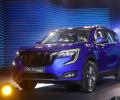
Mahindra & Mahindra (M&M) is largely bullish among analysts following its Q4FY26 results, driven by strong SUV demand, a robust product pipeline, and improving growth visibility across segments, despite near-term margin pressures from rising commodity costs and potential weakness in the tractor cycle.

TVS Motor Company has emerged as India's largest two-wheeler manufacturer by total sales volume in June 2026, surpassing long-standing leaders Hero MotoCorp and Honda Motorcycle & Scooter India, primarily driven by its strong international business performance.

India's automobile retail sales surged by 21.83 per cent year-on-year in June, reaching 25,57,234 units, marking the best June ever recorded across all segments, according to the Federation of Automobile Dealers Associations (FADA).

JSW MG Motor India has unveiled ADAPT, India's first multi-powertrain new energy vehicle (NEV) platform, designed to support electric, hybrid, plug-in hybrid, and range-extender electric vehicles. The company plans to launch one electric SUV and one plug-in hybrid SUV based on this architecture during FY27, aiming to broaden its NEV portfolio and accelerate adoption in India.

Indian car buyers care more about affordability than technology, keeping ICE vehicles dominant while hybrids emerge as the preferred transition option and EVs struggle in the mass market.
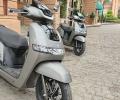
The Delhi government has approved an ambitious electric vehicle policy that eliminates registration fees and road taxes for EVs priced up to Rs 30 lakh, offers a Rs 1 lakh incentive for purchasing new EVs while scrapping old vehicles, and mandates that only electric two-wheelers can be registered starting April 2028.

Mahindra and Mahindra (M&M) recorded the sharpest acceleration among large players, with EV retail jumping to 33,513 units from 7,139 units, an almost 5-fold jump, aided by strong demand for new launches.

Tesla's Model Y L signals a serious push to disrupt India's luxury EV market with more space, power, and aggressive pricing. Priced just 2 lakh above the standard version, it undercuts expectations significantly.
Electric vehicle (EV) retail sales surged 16.37 per cent year-on-year to 22,70,107 units in 2025, driven by a 77 per cent jump in electric passenger car sales, according to data released by dealers' body FADA on Wednesday. The EV makers had recorded a total sales of 19,50,727 units in 2024, the Federation of Automobile Dealers' Association (FADA) said.

Japanese automaker Honda plans to introduce over 10 new models, including electric vehicles and compact SUVs, in India by 2030, identifying India as one of its three key markets for future growth.
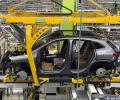
India's total automobile retail sales recorded a significant 9.55 per cent year-on-year growth in May, reaching an all-time high of 25,31,067 units, driven by strong performances in three-wheelers, passenger vehicles, and tractors, despite prevailing heatwave conditions and fuel price pressures.
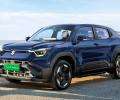
Maruti Suzuki India plans to localise battery production and other critical components over the next few years as part of strengthening the overall EV ecosystem in the country. The company, which plans to launch its first electric vehicle - e VITARA in the domestic market next year, is looking to instill confidence in the buyers as it looks to strengthen the overall EV ecosystem.

Bajaj Auto, the sole player in India's CNG-powered motorcycle segment, has seen a dramatic drop in registrations for its Freedom 125 CNG bike, from a peak of 12,167 in November 2024 to just 1,211 in May this year, primarily due to reduced price arbitrage between petrol and CNG and growing availability challenges.
Top executives from Siam and major carmakers recently met with Heavy Industries Secretary Kamran Rizvi to discuss the matter. Officials from NITI Aayog were also present.
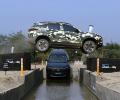
Frankly, I never expected to be offroading in an electric vehicle, let alone an SUV of this calibre, raves Rajesh Karkera/Rediff after a test drive.

With features usually seen in more expensive cars and segment-first paddle shifters, the Tiago offers excellent value for money, says Rajesh Alva/Rediff.com.

Tata Motors' 2026 Tiago facelift is a tech-loaded and safety-focused entry-level hatchback, with prices starting at Rs 4.69 lakh.
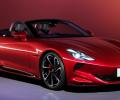
Maruti Suzuki, Tata Motors, Mahindra & Mahindra, Hyundai and MG Motors are gearing up to introduce EVs in India.

Indian carmakers, including Maruti Suzuki and Kia India, reported robust sales growth in May 2026, with both companies achieving their highest-ever monthly sales despite rising fuel prices. Maruti Suzuki's domestic sales surged to 1,93,535 units, while Kia India recorded 27,586 units, driven by strong demand in mini and compact segments and a shift towards electric and CNG vehicles.

Tata Motors emerged as the biggest gainer in the passenger vehicles (PV) market in the second half of FY25, following a GST rate cut in September, achieving the highest growth among major OEMs and overtaking Mahindra & Mahindra in volumes.

About 99,165 electric cars were sold in India in 2024, but electric car penetration -- share of electric car sales in total sales -- was just about 2.5 per cent.

Investors are keenly awaiting clarity on Reliance Jio Infocomm's IPO, the company's AI and data centre strategies, and next-generation leadership structure at Reliance Industries Ltd's (RIL's) 49th annual general meeting (AGM).

Bharat Forge reported modest Q4FY26 results but provided strong guidance, anticipating significant growth from its defence, aerospace, and data centre segments, with a projected 25 per cent revenue growth in Indian manufacturing for FY27, despite current high valuations.

Starting January, the market is expected to welcome models like the Tata Punch 2025 which is expected to be around 6 lakh, Mahindra BE 07 EV around 29 lakh, Maruti WagonR Electric around 8.5 lakh, Toyota 3-Row SUV around 14 lakh, and Volkswagen Tera to be around 8 lakh.

Toyota on January 20, 2026, officially entered India's mass electric vehicle segment with the maiden launch of the Toyota Urban Cruiser Ebella in Mumbai.

Escalating geopolitical tensions in West Asia are beginning to disrupt India's automotive supply chain, leading to rising commodity prices, logistics bottlenecks, material shortages, and pressure on consumer demand, with two-wheeler makers already raising prices.

koda Auto Volkswagen India aims to capture a 5 per cent share of India's passenger vehicle market by 2030, driven by new product launches, including alternate fuel vehicles, and a potential entry into the high-volume sub-4 metre SUV segment.

Traversing from being just vehicle manufacturers to mobility solutions providers amid a raging debate over which eco-friendly technology must be incentivised, the Indian automobile industry is driving in the new year under the shadow of a slowdown in sales with the post-pandemic pent-up demand in distant memory. The shift in the auto industry -- where advanced technologies like autonomous driving, vehicle intelligence, connected features and electrification are quickly gaining traction -- will be reflected in the upcoming Bharat Mobility Global Expo in which India's flagship Auto Expo has been clubbed to be held from January 17-22, 2025 in Delhi-NCR.
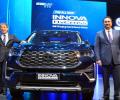
Grant Thornton Bharat's latest survey indicates that hybrids are set to consolidate market share this festive season, bridging the gap between conventional petrol engines and the emerging electric vehicle segment.
